Professional 3D TECH | ADDITIVE Products & Services

Log in

3D Printing for Gaskets Seals Silicone Rubber

Option #1 Indirect with MJP

It is often advantageous to use rapid prototyping in the fabrication process of another part. The 3D printed part is typically destroyed or discarded after being used and can make one or more of the final desired part. This type of process is termed “indirect manufacturing” or “indirect prototyping” and the 3D printed parts are commonly referred to as “indirect tooling.” Many traditional manufacturing processes can leverage rapid prototyping in this way, the most common uses being plastic injection molding, thermoforming, sheet metal forming, sand/investment/flask casting, indirect and direct printed silicone/urethane molding and wax molding for investment casting.

Upper image = Silcone Mask – production ready

Lower image = ProJet 2500 MJP 3D printed eggshell mould in M2-TAN resin

EggShell MJP Silicone Mask 3D Printed

Option #2 Direct Printing with DLP

A mid-tear strength, production-grade rubber combined with Shore 65A hardness and a high elongation at break.

Figure 4® RUBBER-65A BLK material is specially formulated to address key customer needs for rubber parts featuring production performance properties and production mechanical properties, in the light of specifications tested according to industry standards. It is a mid-tear strength material for the production of medium hard rubber parts with slow rebound, for applications such as grips, handles, gaskets, bumpers, seals, vibration dampening components and more.

Rubber 65A

Option #3 Direct Printing with FGF

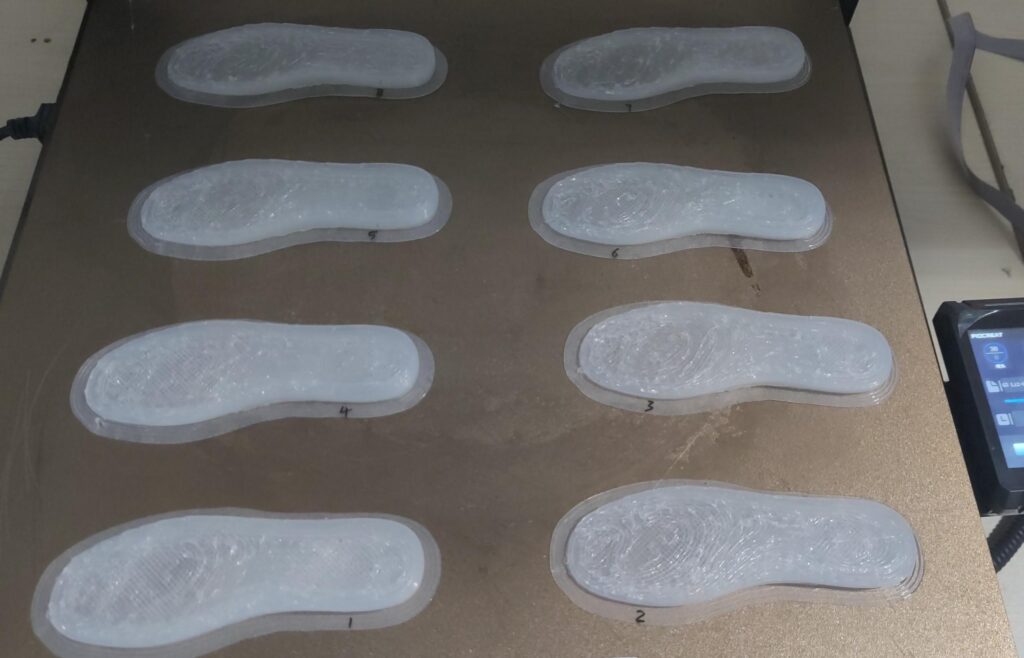
3D Printing TPU | TPE with FGF pellet 3D Printers

Advantages of FGF Printing with TPU | TPE
  • Cost-effective: FGF printing uses pellets, which are generally more affordable than filament. This makes it a cost-efficient option for large-scale production or industrial applications.
  • Enhanced material properties: FGF allows for precise control over the extrusion and cooling process, ensuring the printed TPU components maintain their elasticity, toughness, and strength.
  • Versatility in material usage: With FGF printers, users can switch between various materials, including TPU, which makes the process highly adaptable for different applications.
  • Speed and scale: FGF technology is capable of producing large-scale parts more quickly than traditional 3D printing methods, making it ideal for industries like automotive and aerospace.

TPU | TPE Pellets for FGF Printers

Piocreat’s TPU pellets are specifically designed for FGF 3D printing. These pellets are available in transparent, translucent, or colored forms and are free of plasticizers, ensuring that the material offers optimal performance for demanding applications.

Key Characteristics of Piocreat Pellets:

  • High mechanical strength: Ensures durability in applications requiring long-term use and stress resistance.
  • High toughness: Provides the necessary elasticity for flexible applications while maintaining structural integrity.
  • Wear resistance: Makes TPU ideal for parts that are subject to constant movement or friction, such as gears or protective cases.
  • Oil resistance: Ensures that printed parts can withstand exposure to oils, greases, and other industrial chemicals.

These features make Piocreat’s TPU pellets an excellent choice for industries looking to 3D print components that combine flexibility and strength.

Applications of TPU 3D Printing

Applications of TPU | TPE 3D Printing

Thanks to its unique properties, TPU is widely used across several industries, each benefiting from the material’s versatility, durability, and elasticity.

1. Rapid Prototyping

TPU is an excellent material for rapid prototyping due to its flexibility and strength. Engineers and designers can create functional prototypes that accurately mimic the final product’s mechanical properties, enabling thorough testing and design refinement. This is particularly valuable in industries such as automotive and aerospace, where parts often need to withstand high stress and impact during real-world use.

2. Automotive

In the automotive sector, TPU is used to print parts like gaskets, seals, and shock absorbers. The material’s flexibility and oil resistance make it ideal for parts exposed to constant motion and harsh environments. 3D printing with TPU also allows for the customization of components, such as dashboard elements or protective covers, enhancing both functionality and aesthetics.

3. Aerospace

The aerospace industry demands lightweight yet strong materials, and TPU fits the bill. Components such as protective covers, insulation parts, and shock-absorbing elements can be produced using 3D printing. TPU’s durability and wear resistance ensure that parts meet the high-performance standards required in aerospace applications.

4. Medical Devices

In the medical field, TPU is used to print prosthetics, orthotics, and medical models. The material’s elasticity allows for the creation of comfortable, flexible prosthetic limbs and custom-fit orthotic devices. Moreover, TPU’s biocompatibility ensures that it can be safely used for medical applications.

5. Manufacturing Aids

In industrial settings, TPU is often used to create custom tooling, jigs, and fixtures. These manufacturing aids need to be both tough and flexible to accommodate various production needs. TPU’s wear resistance and flexibility make it ideal for creating tools that can withstand continuous use in an industrial environment.

Conclusion

TPU | TPE is a versatile material that offers a range of benefits in 3D printing, from flexibility and toughness to wear resistance and oil resistance. When paired with Fused Granulate Fabrication (FGF) 3D printing, TPU pellets like those offered by Piocreat enable the creation of high-performance parts for industries such as automotive, aerospace, and healthcare. Whether you’re engaged in rapid prototyping, producing functional parts, or exploring creative design possibilities, TPU in 3D printing provides the performance and reliability required for diverse applications.