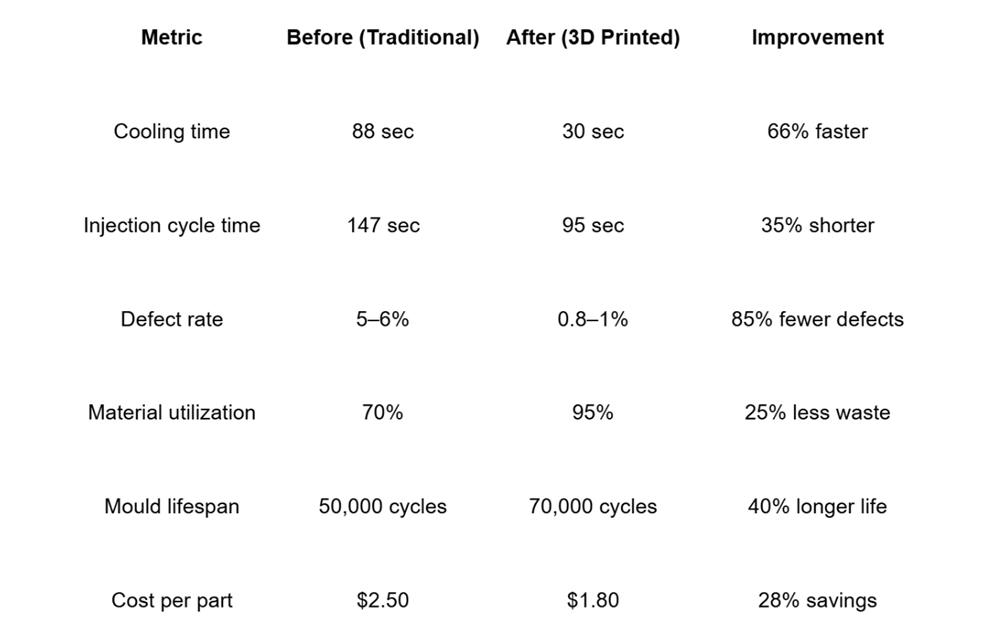
Conformal Cooling with 3D printing is transforming how manufacturers improve efficiency, reduce costs and enhance part quality. That’s where metal additive manufacturing plays a crucial role. With the support of the iSLM280 Selective Laser Melting system from ZRapid, one manufacturer completely rethought its approach to mould cooling, unlocking significant performance improvements. In high-volume manufacturing, particularly in the automotive sector, even small time savings can have a major impact. For this parts supplier, the main bottleneck was not the injection moulding machine or the material, but the mould cooling itself. Cooling alone accounted for 60% of the total cycle time, around 88 seconds, limiting productivity and increasing costs.
Conventional injection moulds rely on straight drilled cooling channels. While simple to produce, they are not designed to efficiently remove heat from complex geometries. These traditional channels often sit too far away from the mould surface, typically 8 to 10 millimetres from the areas where heat builds up most. As a result, cooling is uneven and inefficient.
This creates several common issues including:-
Warping and dimensional inaccuracies
Sink marks and internal stresses
Longer cycle times
Increased defect rates
Higher tooling wear and maintenance issues
For this manufacturer, these limitations resulted in a defect rate of 5-6%, alongside excessive cooling times and reduced tool lifespan.
Straight-line cooling introduces a number of design and performance constraints:-
Channels cannot follow curved or complex mould geometries
Heat is not removed efficiently from critical areas
Coolant flow is disrupted by sharp turns and intersections
Multi-part mould assemblies increase the risk of leaks and misalignment
Ultimately, uneven cooling is one of the leading causes of poor part quality in injection moulding.

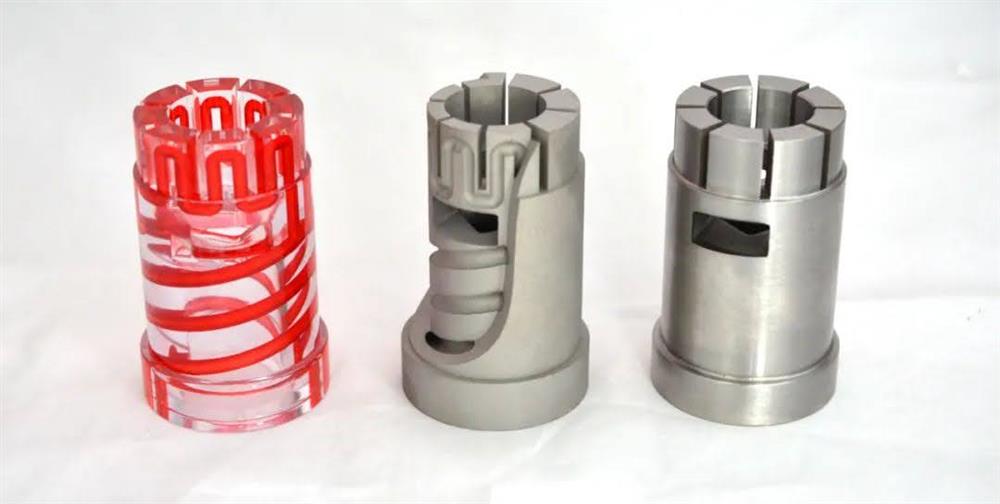
To overcome these challenges, the manufacturer adopted conformal cooling, made possible through metal additive manufacturing. Using advanced Selective Laser Melting technology, cooling channels were redesigned to follow the exact contours of the mould. These channels maintain a consistent distance of just 2-3 mm from the mould surface, dramatically improving heat transfer. The result is faster, more uniform cooling exactly where it is needed.

Conformal cooling channels offer several key advantages:-
Faster heat removal due to closer proximity to the mould surface
More uniform temperature distribution across the tool
Reduced thermal stress and part deformation
Smoother coolant flow with fewer restrictions or dead zones
By eliminating hot spots and improving thermal consistency, manufacturers can achieve higher quality parts with fewer defects.
Using advanced metal 3D printing, two key mould components were redesigned and produced:-
Manufactured in high-strength maraging steel
Designed for complex and hard-to-reach areas
Integrated cooling channels positioned close to the mould surface
Produced with high precision for optimal thermal performance
Manufactured as a single component using tool steel
Multi-loop cooling channels built directly into the structure
Eliminated the need for assembly, reducing the risk of leaks and misalignment
Improved durability and overall tool lifespan
Following the implementation of Conformal Cooling, the manufacturer achieved:-
Up to 35% reduction in cycle times
Significant decrease in defect rates
Improved part consistency and surface quality
Increased production efficiency
Reduced material waste and tooling issues
These improvements quickly translate into measurable cost savings and higher production output.

Material selection played a key role in the success of this application. The tooling materials needed to withstand repeated thermal cycling, high pressure and mechanical wear.
High-performance steels provided:-
Excellent strength and durability
Good thermal conductivity
Resistance to thermal fatigue and deformation
These properties ensure reliable long-term performance in demanding production environments.
To ensure consistent performance, several post-processing and validation steps were carried out:-
Heat treatment to improve strength and relieve internal stresses
Precision machining and polishing for tight tolerances
Simulation of cooling performance before production
Real-world testing using thermal monitoring and sensors
This approach ensures that the tooling performs reliably under real manufacturing conditions.
The success of conformal cooling depends heavily on intelligent design. Advanced CADCAM tools allow engineers to optimise cooling channel layouts and simulate performance before manufacturing. Software such as Cimatron Conformal Cooling is widely used to design efficient conformal cooling systems, helping manufacturers achieve the best possible thermal performance while reducing development time.
This application demonstrates how additive manufacturing is moving beyond prototyping and into full-scale production tooling.
By adopting conformal cooling, manufacturers can achieve:-
Faster production cycles
Higher quality parts
Longer-lasting tooling
Lower overall manufacturing costs
While particularly valuable in the automotive industry, this approach is increasingly being adopted across medical, consumer and industrial sectors.
After switching to 3D-printed conformal cooling, the improvements were significant: